Description
Description
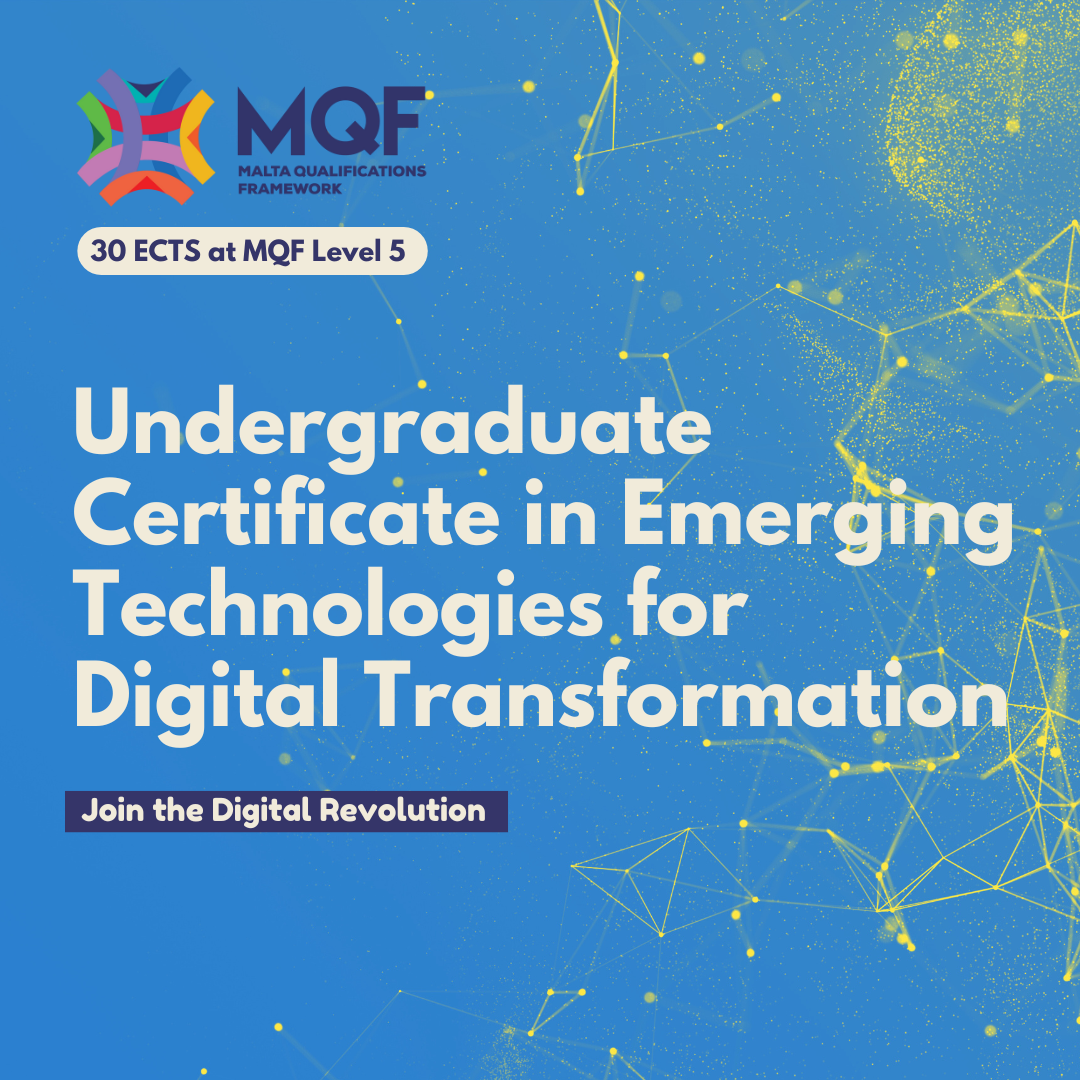
The Undergraduate Certificate in Emerging Technologies for Digital Transformation is a blended part-time, MQF Level 5 Higher Education Course/Programme designed to equip learners with practical knowledge and skills to evaluate and apply emerging technologies for business innovation and growth. Delivered through a flexible blended learning format, the course spans ten months and awards 30 ECTS.
With an emphasis on digital transformation, the programme provides a comprehensive understanding of five key technology domains: Artificial Intelligence (AI), Blockchain, Internet of Things (IoT), Extended Reality (XR), and overarching strategies for technology adoption. Each module focuses on both theoretical insights and real-world applications, enabling learners to assess organisational needs, design appropriate digital solutions, and lead implementation strategies that improve efficiency and competitiveness.
Learners will benefit from an engaging pedagogical model combining live online sessions, face-to-face workshops, asynchronous learning activities, and project-based assignments. The course is aimed at professionals seeking to future-proof their careers or contribute to innovation within their organisations, particularly in roles such as Digital Project Manager, Change Management Consultant, or Technology Adoption Specialist.
Whether upskilling or transitioning into a new digital role, this certificate empowers participants to make informed decisions, harness the power of emerging technologies, and drive meaningful change across business environments.
The programme comprises a total of 750 learning hours. This workload is distributed across 150 contact hours, 450 hours of independent self-study, and 150 hours dedicated to assessment.
Learning Outcomes
Learning Outcomes
Outcome Type:
Skill
The learner will be able to:
a) Construct a detailed business model plan, integrating at least two emerging technologies and outlining their potential benefits and impacts.
b) Match appropriate technology solutions to a given business area or process needing simplification or optimisation, and provide a clear implementation roadmap.
c) Develop and present a comprehensive training module to enable staff to use chosen emerging technologies in their daily tasks competently.
Outcome Type:
Knowledge
The learner will be able to:
a) Describe three specific ways that digital technologies can transform a chosen business’s operations, illustrating with a case study.
b) Analyse a given business model and identify at least two key areas/aspects which can benefit from a technological upgrade, providing a detailed report outlining the rationale and potential impact of these upgrades.
c) Assess and select at least two relevant emerging technologies that can enhance efficiency, reduce costs, and increase competitiveness and profitability of a specific business model, justifying the choices with comprehensive cost-benefit analyses.
Requirements:
Applicants must meet the following entry requirements:
a) Hold a qualification at MQF Level 4 (e.g., one A-level or equivalent in any subject);
b) Possess a pass in English Language and Mathematics at MQF Level 3 (O-Level or equivalent);
c) Have at least 2 years of work experience in a technology-enhanced environment; and
d) Demonstrate a basic level of digital competence, including the ability to access online learning platforms and participate in blended learning activities.
Learning Outcomes for Module 1: Emerging Technologies for Digital Transformation
Outcome Type:
Competences
At the end of the module, the learner will have acquired the responsibility and autonomy to:
a) Integrate specific technologies into their business strategies, as demonstrated by creating a detailed strategic plan.
b) Identify and evaluate at least three different emerging technologies, as evidenced by a comparison report on their business applications.
c) Lead a digital transformation initiative in a simulated business scenario, supported by a presented step-by-step transformation roadmap.
Outcome Type:
Knowledge
At the end of the module, the learner will be able to:
a) Articulate how specific technologies can transform a given business, using at least three case studies to illustrate these transformations.
b) Pinpoint at least two aspects of a business model that require technological upgrades, backed up by a detailed analysis report of these aspects and the proposed upgrades.
c) Choose appropriate technologies for identified business aspects needing change or upgrades, demonstrated through a comprehensive implementation plan for improved effectiveness and efficiency.
Outcome Type:
Skills
At the end of the module, the learner will have acquired the following skills:
a) Construct a successful business model that integrates chosen technologies, showcased by a comprehensive plan.
b) Apply specific technologies to enhance at least three different areas of a business, demonstrated through a detailed application proposal.
c) Operate chosen technologies proficiently, assessed via practical exercises and role-play scenarios performed throughout the course.
At the end of the module, the learner will be able to:
a) Exhibit a clear understanding of how specific emerging technologies facilitate digital transformation, illustrated through a presentation showcasing real-world business applications.
b) Anticipate and prepare for future technological development in their business sector, evident from a forward-looking strategy plan.
c) Amend their existing business plans to accommodate digital transformation, seen through a revised business plan incorporating emerging technologies.
At the end of the module, the learner will be able to:
a) Utilise the basic knowledge of specific technologies in their business, demonstrated through the presentation of a strategic technology adoption plan.
b) Devise a comprehensive business plan for digital transformation, incorporating at least two emerging technologies.
c) Execute these technologies proficiently in their own business, as assessed through a series of practical exercises.
Learning Outcomes for Module 2: Artificial Intelligence (AI)
Outcome Type:
Competences
At the end of the module, the learner will have acquired the responsibility and autonomy to:
a) Analyse and respond to business challenges and opportunities by applying Artificial Intelligence, as demonstrated by creating a strategic plan for integrating AI in business scenarios.
b) Execute specific tasks utilising AI technologies to improve business outcomes, shown through case study simulations.
c) Systematically monitor and analyse market conditions using AI-based tools, as evidenced by market trend reports produced using these tools.
Outcome Type:
Knowledge
At the end of the module, the learner will have garnered the knowledge and understanding of:
a) Articulate AI concepts, their use, and potential implications.
b) Discuss the importance of AI in digital transformation and its potential for integration within an organisation/business.
c) Identify and detail at least three different areas/departments within a business that could optimally use AI to enhance business operations.
Outcome Type:
Skills
At the end of the module, the learner will have acquired the following skills:
a) Apply AI to two specific business operations.
b) Use AI proficiently across two different business sectors.
c) Illustrate how AI facilitates digital transformation in a business.
At the end of the module, the learner will be able to:
a) Design a comprehensive business strategy that incorporates AI for the digital transformation of a business.
b) Identify a specific department/sector within an operation and design strategies to apply AI in a business.
c) Execute basic AI operations, proven by a series of practical exercises.
At the end of the module, the learner will be able to:
a) Construct robust AI-based business strategies.
b) Utilise AI to precisely target, compile, and address customer/client needs.
c) Achieve improved return on investment and increased profits by using AI solutions to automate, simplify, and streamline operations.
Learning Outcomes for Module 3 – Blockchain Technologies
Outcome Type:
Competences
At the end of the module, the learner will have acquired the responsibility and autonomy to:
a) Integrate blockchain technology into business processes, demonstrated through creating a blockchain implementation plan.
b) Execute specific tasks utilising blockchain technology as part of digital transformation initiatives, demonstrated through practical exercises.
c) Oversee and manage cryptocurrency transactions, showcased through the successful completion of simulated transactions.
Outcome Type:
Knowledge
At the end of the module, the learner will have understood the following:
a) Comprehend the fundamental principles and mechanics of blockchain technology.
b) Explain the practical applications of blockchain technology in a business context.
c) Analyse how blockchain technology can enhance a business during digital transformation.
Outcome Type:
Skills
At the end of the module, the learner will have acquired the following skills:
a) Apply the principles of blockchain technology in two business scenarios.
b) Demonstrate practical understanding and application of blockchain technology across two business sectors.
c) Develop and execute two business transformation strategies that include blockchain technology.
At the end of the module, the learner will be able to:
a) Leverage blockchain technology to enhance two business operations in emerging markets.
b) Revise existing or create new business strategies that align with market needs using blockchain technology.
c) Facilitate digital transition in a business by implementing blockchain technology.
At the end of the module, the learner will be able to:
a) Develop a strategic plan using blockchain technology to streamline and optimise operations.
b) Identify two business sectors where blockchain technology has the potential to be applied.
c) Design and execute two basic blockchain operations.
Learning Outcomes for Module 4 – Internet of things (IoT)
Outcome Type:
Competences
At the end of the module, the learner will have acquired the responsibility and autonomy to:
a) Design an integrated technological network that connects different devices across various business sectors, demonstrated through creating a connectivity blueprint.
b) Engineer an autonomous system applicable to a business sector.
c) Oversee and manage data flow within a business context, exemplified by managing a simulated data flow scenario.
Outcome Type:
Knowledge
At the end of the module, the learner will have the ability to:
a) Define and illustrate the core components and mechanics of the Internet of Things.
b) Describe the role and application of IoT in data and cloud computing.
c) Analyse how the application of IoT can revolutionise a business.
Outcome Type:
Skills
At the end of the module, the learner will have developed the ability to:
a) Architect a technological network that connects various devices across multiple locations.
b) Conceptually develop a central control system that oversees multiple business operations.
c) Manage a business operation centrally from a single device/location.
At the end of the module, the learner will be able to:
a) Incorporate IoT into applications to simplify data analysis in developing markets.
b) Craft or update a business strategy that aligns with the needs of a developing market.
c) Design and implement IoT systems to facilitate digital transformation in a business.
At the end of the module, the learner will be able to:
a) Apply IoT knowledge to enhance business operations.
b) Develop a competitive business strategy integrating IoT and other emerging technologies.
c) Utilise IoT to connect and manage all aspects of a business remotely.
Learning Outcomes for Module 5 – Extended reality (XR)
Outcome Type:
Competences
At the end of the module, the learner will have acquired the responsibility and autonomy to:
a) Incorporate Extended Reality (XR) within business strategies, demonstrated by creating a strategic blueprint that includes XR technology.
b) Identify the ethical standards of XR use.
c) Drive productivity and efficiency improvements through XR integration in a business.
Outcome Type:
Knowledge
At the end of the module, the learner will have an understanding of:
a) Comprehend the basic principles and application of Virtual Reality (VR), Augmented Reality (AR), and Mixed Reality (MR).
b) Identify and evaluate the ethical considerations involved in developing and using XR applications.
c) Analyse the potential benefits and challenges of XR applications in a business context.
Outcome Type:
Skills
At the end of the module, the learner will have acquired the following skills:
a) Conceptually design two XR applications in a chosen business context.
b) Explain how XR can transform a business.
c) Identify the proper use of XR-based applications.
At the end of the module, the learner will be able to:
a) Implement XR technology within a business context.
b) Formulate a business strategy that incorporates XR to improve business outcomes.
c) Utilise XR technology in product presentations.
At the end of the module, the learner will be able to:
a) Identify three ways in which XR technology enhances competitiveness.
b) Align business strategy with market needs using XR.
c) Deploy XR technology to facilitate the digital transition in a business.
Full Programme Info
1. Programme Title
Undergraduate Certificate in Emerging Technologies for Digital Transformation
2. Accredited Status
This programme is accredited by the Malta Further and Higher Education Authority (MFHEA) at MQF Level 5, with 30 ECTS.
3. Qualification Level
MQF Level: 5
EQF Level: 5
4. Total ECTS
30 ECTS
5. Mode of Delivery
Blended learning with 90% of contact hours delivered online and 10% of contact hours delivered face-to-face.
6. Mode of Attendance
Part-time
7. Programme Duration
10 months (part-time)
8. Total Learning Hours
750 hours, broken down as follows:
– Contact Hours: 150
– Self-Study: 450
– Assessment: 150
9. Workload by Module (each 6 ECTS)
5 Modules x 150 hours each = 750 total hours
Each module includes: 30 contact hours, 90 self-study hours and 30 assessment hours
10. Programme Structure
Module 1: Emerging Technologies for Digital Transformation
Module 2: Artificial Intelligence (AI)
Module 3: Blockchain Technologies
Module 4: Internet of Things (IoT)
Module 5: Extended Reality (XR)
11. Exit Awards (Each 6 ECTS, MQF Level 5)
Award in Emerging Technologies for Digital Transformation
Award in Artificial Intelligence for Digital Transformation
Award in Blockchain Technologies for Digital Transformation
Award in Internet of Things for Digital Transformation
Award in Extended Reality for Digital Transformation
12. Target Audience
Adults aged 20 years+
13. Target Group
Professionals seeking to understand and implement emerging technologies for business innovation and digital transformation.
14. Language of Instruction
English
15. Entry Requirements
– MQF Level 4 qualification (e.g., 1 A-Level or equivalent)
– Pass in English and Mathematics at MQF Level 3 (O-Level or equivalent)
– Minimum 2 years’ work experience in a tech-enhanced environment
– Basic digital competence
16. Delivery Locations
In-Person: To be confirmed
Online synchronous: Google Meet
Online asynchronous: EIET Virtual Learning Environment (https://www.eiet.edu.mt)
17. Assessment Methods
100% continuous assessment via written assignments per module
Pass mark: 50%
One reassessment opportunity offered
Grading scale from 35% (fail) to 80%+ (distinction)
18. Teaching and Learning Approach
Flipped classroom with asynchronous and synchronous components including online lectures, case studies, discussion boards, project work, peer learning, simulations, and virtual learning tools.
19. Learning Outcomes
Each module has defined outcomes in:
Autonomy and Responsibility
Knowledge and Understanding
Skills (including digital skills and competences)
Contact us for the full list of learning outcomes.
20. Occupational Relevance
Prepares learners for roles including:
– Digital Transformation Consultants
– Digital Project Managers
– C-level Executives
– Change Management Consultants
– HR Professionals in tech contexts
21. Regulated Profession
This qualification does not lead directly to a regulated profession.
22. Grading System
– Distinction: 80%+
– Merit: 70–79%
– Credit: 60–69%
– Pass: 50–59%
– Fail: <50%
Contact us for the full grading system.
23. Pass Rates
To be published once available after the first cohort.
24. Next Intake
To be confirmed
25. Programme Fees
2499EUR
26. Registration Method
Register via https://www.eiet.edu.mt
27. Visa Information (for third country nationals)
Link to Identity Malta’s VISA Unit
28. Further Learning and Career Support Contact
For advice on next steps and career pathways contact us via https://www.eiet.edu.mt/contact-us/